
The Great Ethereum Vanishing Act: Navigating the 2026 Scarcity
If you have been keeping a close eye on the digital asset markets this March, you’ve likely noticed a curious phenomenon. Despite the usual noise of global headlines and geopolitical shifts, Ethereum (ETH) is quietly undergoing a fundamental transformation. As a long-time observer of market structures, I find the current “supply crunch” to be one of the most compelling narratives for entrepreneurs and investors alike.
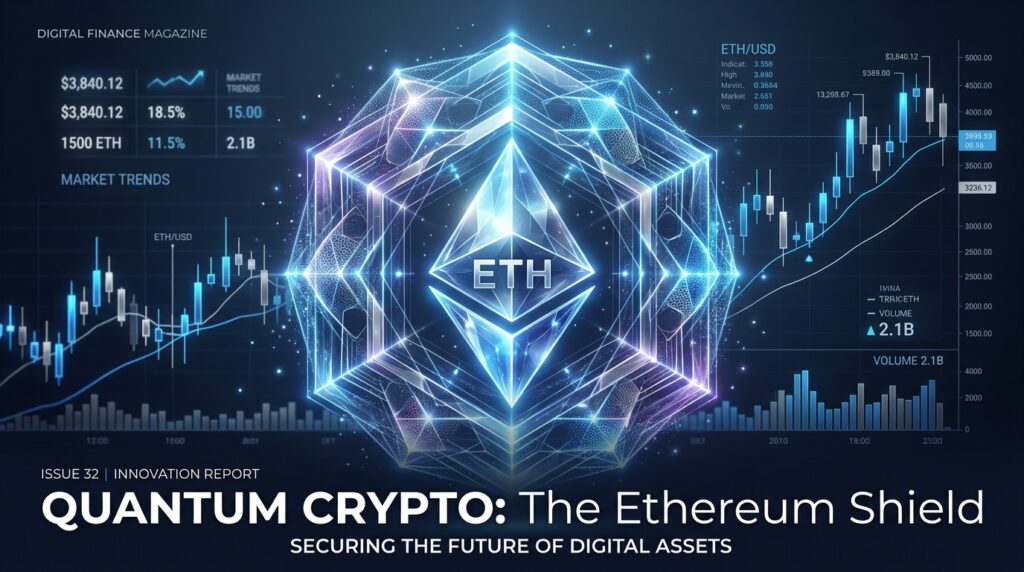
We are currently witnessing a dual-track evolution: a massive migration of ETH away from tradable exchange balances and a proactive “fortress building” phase against the future threat of quantum computing. Let’s break down what this means for the average participant in the global economy.
The Numbers Behind the Crunch
The data from late March 2026 is staggering. For the first time since the early days of 2016, the amount of Ether available on centralized exchanges has plummeted to historic lows. On platforms like Binance, balances have dipped toward levels last seen in December 2020—roughly 3.3 million ETH. But where is all that capital going?
The answer lies in staking. Currently, over 38.1 million ETH is locked in the network’s security layer. That represents a whopping 33.1% of the total supply that is no longer available for immediate sale. From a business perspective, this is a classic “illiquid capital” shift. When supply tightens this significantly, the price sensitivity to any new demand increases exponentially.
| Metric | Current Value (March 2026) | Market Impact |
|---|---|---|
| Total ETH Staked | 38.1 Million | High Scarcity |
| Supply Percentage Locked | 33.1% | Reduced Sell Pressure |
| Validator Entry Wait Time | ~50 Days | High Sustained Demand |
| Exchange Balances | Lowest since 2016 | Increased Volatility Potential |
The “Quantum Deadline”: 2029
Scarcity is only half the story. As an entrepreneur, I’ve always believed that the best systems are those that plan for threats five to ten years out. This week, Ethereum developers officially launched a “Post-Quantum” team. Their goal? To protect the blockchain from the eventual arrival of quantum computers capable of breaking current cryptographic standards.
Interestingly, this move mirrors a deadline set by Google, which has also targeted 2029 as a critical year for system encryption. The Ethereum Foundation is moving to implement protocol-level solutions well before the threat arrives. As I often tell my peers, security is not a feature; it is the foundation of trust. By addressing these “edge cases” now, the network is signaling to institutional banks that it is a safe harbor for long-term settlement.
Why Business Leaders Should Care
You might ask: “Does the validator churn rate or the exit queue really matter to my bottom line?” The answer is yes. These technical constraints limit how quickly supply can re-enter the market. Even if market sentiment shifts tomorrow, the “exit queue” for staked Ether acts as a natural brake, preventing the kind of flash-crashes we saw in the previous decade.
Furthermore, the rise of tokenized real-world assets (RWA) is fueling this demand. Industry executives recently testified before the US House Committee on Financial Services, arguing that applying existing surveillance to tokenized securities could revolutionize manual record-keeping. Ethereum is the primary playground for this “re-imagining” of US financial markets.
In my view, we are entering a “New Phase” where ETH acts less like a speculative token and more like a scarce, high-yield digital bond. For those of us looking to preserve wealth and build scalable digital infrastructure, this transition from “inventory” to “infrastructure” is the most important trend to watch this year.
For more detailed data on the current supply dynamics, you can view the latest analysis at Cointelegraph or read about the technical security updates on Decrypt.
Final Thoughts for the Week
Success in this space requires patience and a focus on the “plumbing.” While the headlines focus on daily price swings, the smart money is looking at the 50-day validator queues and the post-quantum roadmaps. Stay informed, stay secure, and remember: in a digital world, scarcity is the ultimate currency.